




Scaling our Platforms
Innovation that closes critical healthcare gaps
As a system-critical healthcare company, Fresenius benefits from strong global trends: rising healthcare spending, increasing chronic diseases and the growing need for efficient, affordable and innovative solutions.
Click on each card to explore more details
Did you know?
Longevity Gap
disease-burdened life years
Longevity Gap
By 2030, 1.4bn people will be over 60; 84% of 67M deaths will be from chronic disease
Source: Global Burden of Disease, Institute for Health Metrics and Evaluation (2022)
Workforce Gap
healthcare worker shortfall
Workforce Gap
The World Health Organization estimates a projected shortfall of 10 million health workers by 2030
Source: WHO Health Workforce (2023)
Efficiency Gap
GDP on health expenditure
Efficiency Gap
Health expenditures will rise to more than 10% of global GDP by 2030
Source: OECD Health at a Glance (2019)
This is why the second priority of our Rejuvenate phase focuses on scaling three therapy platforms designed to deliver better outcomes for patients and payers:
Innovative (Bio)Pharma
Expanded MedTech
Digitized Care Provision
Scaling is not just about size. It is about relevant product advances, innovations to each platform and sustainable impact across the healthcare ecosystem as a whole.
What we need are the latest generation of affordable medicines for critical and chronic diseases, along with clinical nutrition solutions tailored to individual medical needs. Similarly, precise, targeted medical technology and holistic – and digitally enabled – care along the entire patient journey are equally essential.

Innovate (Bio)Pharma: Innovation and specialization
For (Bio)Pharma, this means innovation! We need to bring the latest generation of molecules and products to the market and keep filling the pipeline. Scaling (Bio)Pharma means accelerating innovation and continuously strengthening our pipeline across Pharma, Nutrition and Biopharma.
Biopharma is among the fastest-growing healthcare segments. Biosimilars make complex biological treatments more affordable and accessible, particularly in oncology and autoimmune diseases. Fresenius is expanding its biosimilar business to provide more patients with access to biological therapies.
Can you guess?
How large are the estimated annual savings across the EU and U.S. through biological treatments?
Source: Biosimilars Council and IQVIA reports
2025 marked an unprecedented year for our biosimilars portfolio, with two approvals and three launches. The growth of our Tyenne biosimilar and innovations such as the Otulfi autoinjector and Bomyntra – a biosimilar available in both a prefilled syringe and a vial – further strengthened our position.
Nathalie’s Story: Living fully with a chronic disease
Nathalie Oliveira, a longtime Fresenius Kabi colleague, lives with a chronic disease that ended her surgical career – but not her dedication to healthcare. Finding the right biological treatment was crucial in managing her fatigue and maintaining her quality of life.
Her story embodies our mission: enabling patients – and colleagues – to live fully, supported by the therapies we develop and deliver.
“Having a chronic disease should not stop you in your journey in life.”
Expand MedTech: Precise and smart technologies
For MedTech, this means expansion! Scaling MedTech means strategically expanding our device portfolio and integrating technologies more closely into emergency and surgical settings. Connectivity and digital integration are key: from devices to hospital management systems and enhancing digitalization to seize new opportunities and meet customer needs.
Strong partnerships to accelerate innovation
In neonatal intensive care, this commitment translates into supporting pioneering research for the most vulnerable patients: extremely premature infants. A joint research team in Rome is exploring an innovative transfusion approach for extremely premature newborns. Instead of using adult donor blood, which may release oxygen too rapidly and stress fragile tissues, the team is investigating the use of red blood cells derived from umbilical cord blood – naturally rich in fetal hemoglobin and potentially better suited to the physiology of these tiny patients.

Turning this vision into a scalable clinical study required advanced preparation processes and close collaboration. Fresenius Kabi contributed technical expertise, specialized equipment, and hands-on training for eight neonatal intensive care units across Italy. Together with leading physicians this partnership demonstrates how precise technologies, smart device integration, and strong clinical collaboration have the potential to open new pathways in patient blood management.
A further example of strengthened partnerships in 2025 is the European EASYGEN consortium. The aim: help transform CAR-T cell therapy to make innovative therapies more affordable and accessible in the future.
Digitize Care Provision: Digitally enabled & integrated care
For Care Provision, this means digitalization! The seamless use of digital technologies and AI throughout the entire patient journey improves the quality of care and reduces the workload on hospital staff. At Fresenius Helios, we want to harness these opportunities even more effectively.
Quirónsalud’s Jiménez Díaz hospital in Madrid
80
%of their treatment time through enhance digitalization.
Source: Example refers to oncology day hospital treatments by Quironsalud in the hospital Jimenez Diaz Madrid (FY/25 Investor presentation)
Next-level digital tools and AI for better patient care
Digitalization and AI continued to transform everyday clinical practice in 2025. Scaling our Care Provision platform means that we are steadily expanding digital technologies across our hospitals, leveraging our distinctive strengths: direct patient access, rich clinical data, and deep medical expertise. We are investing in AI and digital transformation to enhance clinical decision-making, streamline workflows, and elevate patient experience.
A prime example is our proprietary platform Casiopea, our digital health ecosystem, which today has ~9 million active users in Spain. Virtually all medical activities are now registered on this platform, creating a seamless and connected patient experience.
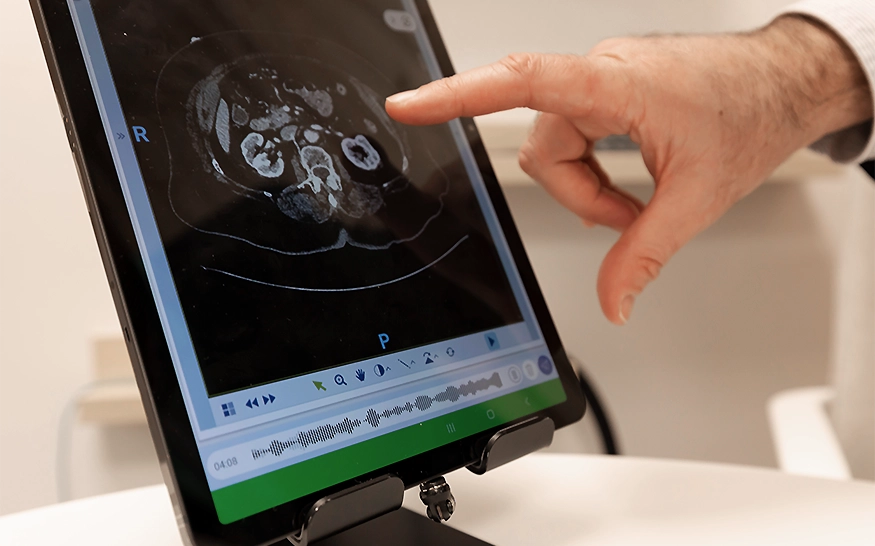
The AI-based large language model Scribe has now been used to document more than one million doctor-patient consultations. More than 5,000 medical professionals actively use the system, with consistently positive feedback — saving time and allowing physicians to focus more fully on their patients.

Advanced robotics and AI-supported diagnostics
Beyond this, we are rolling out a broad network of digitally and AI‑supported diagnostics, including radiological image data analysis, emergency care decision support or digital pathology. These initiatives make care smarter and more patient‑centric, improving outcomes and reducing treatment times. Our systems consistently deliver medical quality above market benchmarks.
The Ion robotic-assisted bronchoscopy system at Fresenius Helios lung cancer centers shows how advanced robotics are transforming hospital diagnostics. Using high-resolution imaging and software that creates a digital twin of the patient’s airways, physicians can precisely navigate to millimeter-small lung lesions that were previously unreachable. This innovation enables much earlier and more accurate detection of lung cancer, often before symptoms appear. As a result, hospitals can offer faster diagnoses, lower complication risks, and significantly improved chances for curative treatment.
“The new robotic system for bronchoscopy is a game changer. This allows us to reach the deepest lung tissue and can even reach millimetre-sized suspicious tissue compaction – and take samples. This was previously not possible endoscopically.”
These innovations underpin our quality leadership. Combined with best-in-class healthcare professionals and state-of-the-art hospitals, Fresenius Helios remains the top choice for patients seeking exceptional care.